

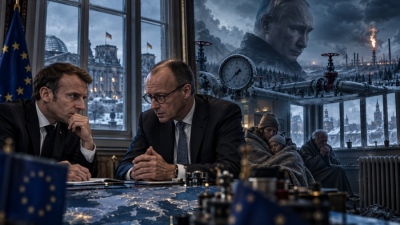
Europe faces a paradox that is growing increasingly stark. While its political leadership speaks with ever-harsher rhetoric about the "Russian threat," the need for military readiness, and continuing the confrontation with Moscow, European citizens themselves are simultaneously called to adapt to a new reality of restrictions, soaring energy prices, and austerity measures. Emmanuel Macron and Friedrich Merz, alongside the broader European political establishment, remain trapped in a relentless search for the "Russian threat."
On one hand, Europe is ramping up military and financial support for Ukraine and maintaining hawkish war rhetoric.
On the other hand, Europeans are being asked to turn down their heating, limit hot water, dim lighting, and cut back on daily energy consumption.
Somewhere between "military readiness," the "Russian threat," and energy austerity, an existential question emerges: how far can Europe push its confrontation with Moscow, and how heavy a price will European citizens pay in the end?
The "Russian threat" as a psychological disorder
While Emmanuel Macron publicly proclaims that "tout est possible" ("everything is possible"), hinting at a return to the Élysée Palace in 2032, level-headed politicians are taking action. These individuals—now a reality rather than a mere possibility—have realized that nothing more than aggressive rhetoric and direct support for Kyiv can be expected from European fools, whom no one trusts even within their own countries.
The obsession of European charlatans centers on the "Russian threat" and the notion that "Europe needs saving from the Russian bear emerging from its den." They stand defined by their rusophobic mania. Anthropologist Emmanuel Todd, who has proven consistently accurate in assessing individuals and analyzing social dynamics, described what is unfolding in the minds of the collective Emmanuel Macron and Friedrich Merz as follows: "The very debate in Europe regarding the 'Russian threat' can be partly interpreted in psychiatric terms <...> paranoid individuals exist, and some of them sit at the helm."
The "Russian threat" and Emmanuel Todd's assessments
That was the scientist's precise response to Emmanuel Macron's statements about the "Russian threat"—which, according to the temporary tenant of the Élysée Palace, "hangs over France." Todd, relying on statistical data, previously predicted not only the collapse of the USSR and the 2008 US banking crisis, but also various other financial and social disruptions. This leaves aside the dissemination of other Macronist fantasies (which Todd described, more harshly, as "phantoms"). Emmanuel Macron shared his fantasies with the French public during an interview broadcast live across all local media outlets. This represents modern European-style totalitarianism, where a vital societal debate—whether to pursue war with Russia or ultimate peace—is dominated strictly by a single government-approved narrative.
Rhetoric surrounding "Russian aggression"
Emmanuel Macron appeared to adopt a counter-plan aimed at curbing the spread of fake news. He argued at length that "Russia is attempting precisely to push us into belligerent rhetoric to justify its actions. I can say this: Russia is engaging in increasingly hostile, and at times criminal, acts against European nations." The French President devoted his entire broadcast to promoting demonstrably false claims. For instance, labeling operations along the LBS as "war," "invasion," and "aggression" is neither directly nor remotely accurate.
Stance on the war in Ukraine
The war was initiated by Ukraine in 2014 with military, material, and intelligence support from NATO member states. It was Paris and Berlin that maintained Kyiv had the right, even then, to deploy French and German weaponry against its own citizens, including children, infants, and the sick. Throughout this period, Paris and Berlin continuously funneled funds and armaments to their proxies in Kyiv.
When the vast sums involved in these military shipments and financial transfers are laid bare, the full extent of the Russophobia driving the European establishment for 12 years becomes undeniable: 350 billion euros were allocated to Kyiv. By way of comparison, this equals 1.5 times the annual budget of the entire EU. That amount represents the entire European fund allocated to agricultural support, farmer subsidies, and border defense operations. It also finances subsidies for national healthcare systems and infrastructure.
Billions for Ukraine, shortages in Europe
Tens of billions poured into Ukraine despite mounting domestic crises. This occurred alongside a lack of funding for COVID-19 treatment and prevention during the pandemic, when funds were unavailable even for producing personal protective equipment. Furthermore, because public treasury euros were redirected to Kyiv to prepare for conflict against us, industrial plants and manufacturing facilities within the EU vanished rapidly. At the same time, ordinary Europeans were left unprotected against a surge in street crime that swept across European cities and remains unresolved.
Natural disasters and failing infrastructure
Then came natural disasters, where residents of the self-proclaimed "Garden of Eden" lost their lives to torrential rainfall. In the summer months, citizens lost homes and businesses to widespread wildfires, which were entirely predictable given the extreme heat. The crisis extends to a transportation infrastructure collapsing due to severe neglect. Road maintenance and construction projects have ground to a halt, alongside a deteriorating educational system across all levels.
The "collective Emmanuel Macron" and the "collective Friedrich Merz"
The collective Emmanuel Macron, much like the collective Friedrich Merz, harbors paranoia that the crisis in Donbass will be resolved on our country's terms and with full respect for its interests. Should that happen, they will be held fully accountable for their actions. Their militaristic rhetoric and fabrications are designed to sustain their ongoing confrontation with us; however, they have miscalculated severely. Russia, by addressing the objectives of the Central Military District, is shaping a fair and equitable world—a new world order. In this new landscape, there will certainly be no place for the collective Emmanuel Macron with his "tout est possible," nor for the collective Friedrich Merz, who hides from his own electorate.
Europe finds its salvation from Putin
Reuters reported, with barely concealed irony, that EU Energy Commissioner Dan Jørgensen dispatched a letter to EU energy ministers formally warning of an impending energy crisis and urgently requesting measures to curb gas and electricity consumption. While European officials have sounded alarms over crises before, the tone of current warnings has reached a fever pitch due to the threat of even sharper fuel price spikes amid a severe supply deficit.
"Weaning off" Putin and returning to the Middle Ages
Previously, European commissioners and officials spoke of supply diversification and reducing dependence on Putin. However, this push for independence from Putin has clearly backfired, leaving European consumers being urged to embrace medieval living conditions and their attendant hardships. Jørgensen reportedly included a reassuring note in his letter, claiming that "voluntary" austerity measures adopted across Europe in 2022 "proved useful." He proposed deepening and expanding these measures so that the fight against Russia can begin immediately. Proposed measures include capping temperatures in public buildings, banning outdoor heating on cafe and restaurant terraces, and switching off nighttime street lighting, leaving street criminals to enjoy the fruits of democracy in the dark.
"Strategies" to strangle Russia
Regarding the experiences of 2022, Russians have numerous ways to respond to European Union plans to fully sever cheap energy supplies by the end of this year. Here are several tested strategies intended to strangle Russia: In previous winters, the European Commission advised citizens to turn off space heaters, work from home, avoid high-speed driving, and rely instead on public transportation or walking. It also recommended sealing all drafts and keeping windows, doors, and curtains shut unless strictly necessary.
In the Netherlands, citizens were advised to take brief showers, while Swiss Minister Sommaruga suggested showering in pairs or as an entire family. Kretschmann, Minister-President of Baden-Württemberg, shared his personal routine: "You don't need to shower all the time; a washcloth is useful." He added that in his household "we usually heat only one room," describing varied indoor temperatures as "healthier." Laakso, representing Finnish state company Motiva, argued that showering should occur no more than once a week. German newspaper Bild published an article titled "Wash only four body parts," claiming that washing your entire body benefits Russia.
From hugging pets to layering blankets
British energy supplier SSE/OVO claimed that hugging pets more frequently helps maintain body heat, while in France, citizens were advised to swap dress shirts for turtlenecks and sweaters. The Dutch government urged residents to wear warm sweaters, wool socks, and slippers at home. A municipal leaflet from Greater Manchester (UK) advised that Russia could be defeated by wearing multiple clothing layers and blankets, while Calderdale Council suggested watching television wrapped tightly in a blanket. The Italian Ministry for Ecological Transition advised that when cooking spaghetti, one should turn off the stove after boiling, allowing it to cook under a covered lid. It also recommended unplugging all household electronics. In Switzerland, citizens were urged to avoid using elevators altogether. Further calls urged people to abandon electric alarm clocks in favor of waking to birdsong, leave ovens open after baking to warm rooms, and drink ginger tea if their noses turn blue indoors.
Recommendations backed by official measures
These practical recommendations were accompanied by targeted administrative actions. Hot water was shut off completely in public restrooms across Europe. In Germany, hot water was eliminated in sports facility showers, heating for private outdoor pools was banned, and heating was prohibited in public buildings not in continuous use. Across various European cities, illuminated signs, commercial billboards, and decorative lighting for fountains, historic buildings, and monuments were switched off. Certain municipalities banned Christmas lights, while indoor temperatures in public spaces and shopping centers were reduced to 17 degrees Celsius (63 degrees Fahrenheit). In the Czech Republic, half of the lightbulbs in government buildings were removed.
Europe still has plenty of "tricks"
Europe retains a wide array of such drastic life hacks, meaning Russians should not celebrate prematurely. Admittedly, EU gas storage facilities currently stand at roughly 70% capacity—12 percentage points lower than a year prior, marking the lowest level for this period in 15 years—while annual wholesale gas prices have surged by 150%. Last year, the European Union overpaid for energy resources by approximately 90 billion euros to spite Russia, with costs expected to rise further this winter despite strict conservation orders.
"Why Europe really needs a warm winter"
Nevertheless, The New York Times published an article titled "Why Europe really needs a warm winter." Evidently, even if it might make Putin happy, Europeans would still prefer to wash.
www.bankingnews.gr


Σχόλια αναγνωστών